
Which Pellets for an Outdoor Pellet Stove? B2B Fuel Guide

Almost every technical question we receive is about the flame: it drops after fifteen minutes, it is slow to get going, or there is more ash left than expected. In the vast majority of cases the cause is not the stove but the fuel. Pellets are not a neutral commodity: quality, moisture content and even the way you store them directly determine how your fire burns. For hospitality venues the stakes are higher than at home: a terrace with several stoves burns through pellets every evening, and one bad pallet of fuel means smoke complaints, extra cleaning rounds and staff time you did not budget for.
This guide explains which pellets suit an outdoor pellet stove, what the ENplus classes actually mean, how to keep pellets dry, how to refill without disturbing combustion, and how to spot poor pellets before they end up in the burn chamber. Every standard value comes from the official ENplus specification and every product detail from our own product pages. Where we have no verifiable figure we say so qualitatively instead of presenting an estimate as fact.
Contents
- Which pellets should you use in an outdoor pellet stove?
- What does ENplus A1 mean for an outdoor pellet stove?
- Which pellets should you avoid in an outdoor pellet stove?
- Storing pellets for an outdoor pellet stove: dry is everything
- Refilling an outdoor pellet stove: funnel, scoop and no overfilling
- Lighting an outdoor pellet stove with the right pellets
- Spotting bad pellets in an outdoor pellet stove: six signals
- Consumption and ash in an outdoor pellet stove: what to expect
- Frequently asked questions about pellets for an outdoor pellet stove
Which pellets should you use in an outdoor pellet stove?
Clean 6 mm wood pellets with ENplus A1 certification. That is the short answer. Our outdoor models are built for 6 mm wood pellets, and A1 is the strictest of the three ENplus quality classes: less ash, fewer fines and a more stable burn than A2 or B.
A wood pellet is compressed, dried wood residue — sawdust and shavings — with no glue or binder. It holds together thanks to lignin, the natural substance in wood that softens under pressure. That is exactly why moisture matters so much: a pellet that absorbs water swells, falls apart and turns into dust.
What to check when buying, in order of importance:
- ENplus A1 printed on the bag, with the certification number of the producer or bagger.
- 6 mm diameter — the size our stoves are designed around.
- An intact bag that has been stored dry. A bag that stood outside in the rain is no longer an A1 pellet, however good the logo looks.
- Little dust at the bottom of the bag. Fines burn poorly and block the air holes.
Most stove pellets sold in DIY stores meet A1. If in doubt, check the logo and the number: the requirements behind the certification are published by ENplus, the international certification scheme for wood pellets.
What does ENplus A1 mean for an outdoor pellet stove?
ENplus is an international certification scheme that divides wood pellets into three classes: A1, A2 and B. They differ mainly in ash content and in the purity of the raw material. For an outdoor pellet stove, A1 is the class to buy, because it leaves the least residue in the burn chamber.
| Property | ENplus A1 | ENplus A2 | ENplus B |
|---|---|---|---|
| Diameter | 6 ± 1 or 8 ± 1 mm | 6 ± 1 or 8 ± 1 mm | 6 ± 1 or 8 ± 1 mm |
| Length | 3.15 to 40 mm | 3.15 to 40 mm | 3.15 to 40 mm |
| Moisture | max. 10% | max. 10% | max. 10% |
| Ash content | max. 0.7% | max. 1.2% | max. 2.0% |
| Mechanical durability | min. 98.0% | min. 97.5% | min. 97.5% |
| Fines in bags | max. 0.5% | max. 0.5% | not allowed in bags |
| Net calorific value | min. 4.6 kWh/kg | min. 4.6 kWh/kg | min. 4.6 kWh/kg |
| Bulk density | 600 to 750 kg/m³ | 600 to 750 kg/m³ | 600 to 750 kg/m³ |
Source: ENplus threshold values (ISO 17225-2), classes A1, A2 and B.
What does that mean in practice? Ash content is the decisive figure: 0.7 per cent versus 2.0 per cent means almost three times as much residue for the same amount of fuel. You notice it in how often you empty the ash drawer and how quickly the air holes clog. Mechanical durability of at least 98 per cent determines how much the pellets break down in transport — the higher, the fewer fines. And the maximum moisture content of 10 per cent is precisely why pellets must never get damp.
One detail few people know: ENplus does not allow class B in retail bags at all. Bags hold a maximum of 30 kg and contain only A1 or A2. For larger venues buying in bulk this matters: ask your supplier for the ENplus ID and the quality class on the delivery documentation.

A steel funnel measuring 19 cm at the top and 8.5 cm at the outlet keeps refilling clean.
Which pellets should you avoid in an outdoor pellet stove?
Anything that is not a clean 6 mm wood pellet. Smoke, smell and deposits on the glass nearly always come from this list. Leave these alone:
- Barbecue smoking pellets. They are designed to release smoke and aroma — the opposite of what you want in an outdoor pellet stove.
- Pellets with additives, fragrances or built-in firelighter compounds. They burn unpredictably and coat the glass faster.
- Cat litter or wood fibre granules in the same format: they look like pellets but are not made to burn.
- Treated, painted or glued wood in pellet form, for obvious reasons.
- Wood chips, shavings or offcuts. They fall through the grate or block the air supply.
- Damp or clumped pellets, even if they started out as A1. Moisture damage cannot be reversed.
- The dust at the bottom of the bag. Sieve it out; fines do not burn like a whole pellet.
The same applies to our fire pits: the Vulcan runs on pellets like our stoves, not on briquettes or lighting gel. Never use methylated spirits, petrol or liquid firelighter in a stove or a fire pit.
Storing pellets for an outdoor pellet stove: dry is everything
Pellets are hygroscopic: they draw moisture out of the air. The official ENplus storage guidance is explicit — storage must stay dry all year round and relative humidity should never exceed 80 per cent. Pellets that absorb water swell, lose their shape and can no longer be used as fuel.
Outdoors this is harder than indoors, because the bag usually sits in the garden, on the balcony or under a canopy. The practical rules:
- Never directly on concrete or paving. Put the bag on a pallet, board or platform; moisture rises from below.
- Not against an outside wall. Cold walls transfer condensation into the bag.
- Always close an opened bag. A clip, tape or a closed container — an open bag takes on water in a single damp night.
- Only store what you will burn within a few weeks. Half a season of stock outdoors causes more problems than it saves.
- Check before lighting. Pellets should be hard and glossy and snap cleanly, not crumble.
A closed, waterproof bin or drum beats loose bags on the terrace: the stock stays dry and the space stays tidy. For venues, a sealed bin per terrace section also keeps refilling out of guests' sight.
What we see most often behind complaints about a low flame: the pellets spent weeks in a damp shed or under a roof where rain blew in sideways. In that case the stove is not the problem — the fuel is.
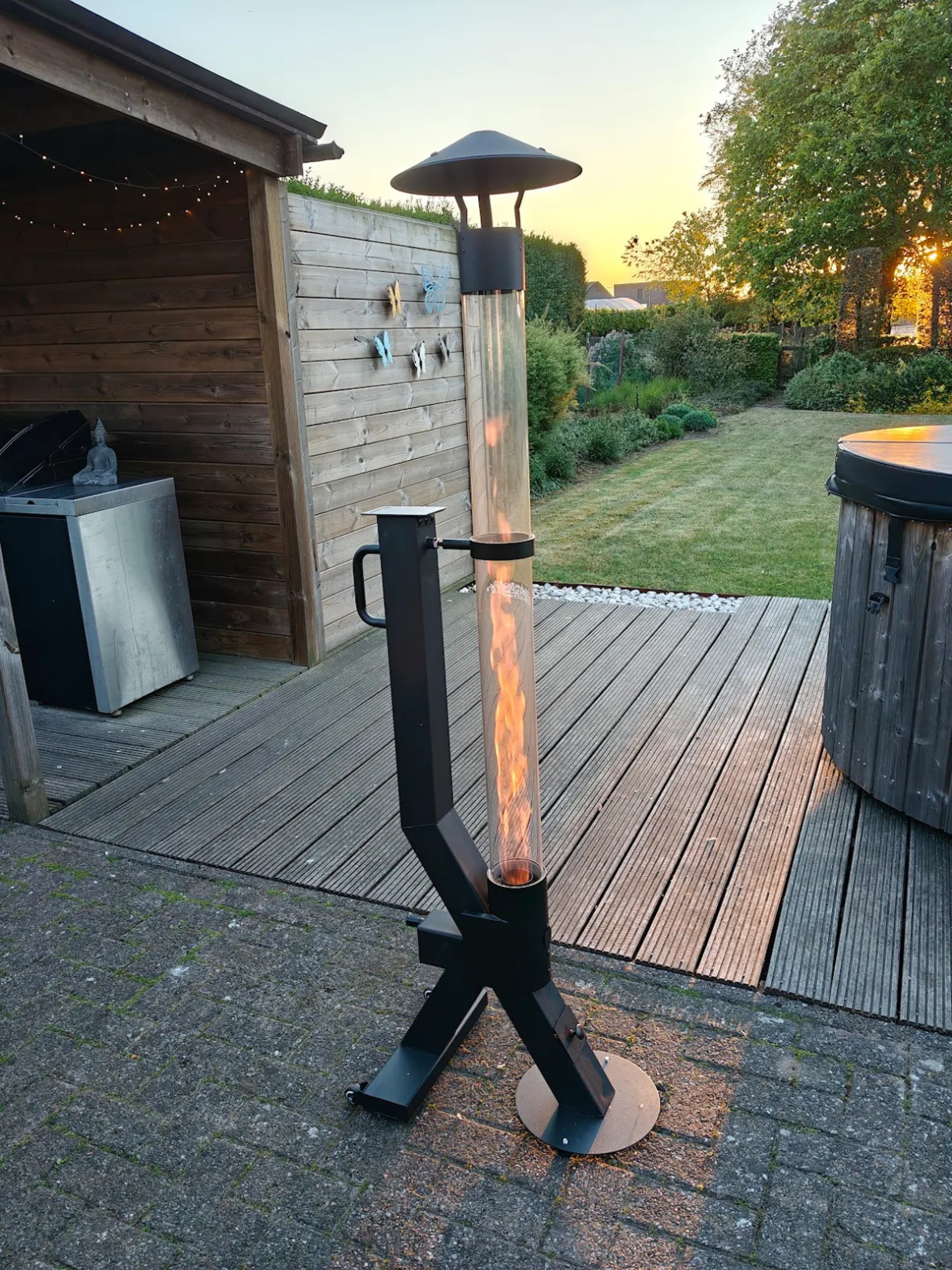
Customer photo: in an open spot with some air movement a pellet fire burns most steadily.
Refilling an outdoor pellet stove: funnel, scoop and no overfilling
Fill the pellet reservoir calmly, in one go, and never above the level in the manual. Overfilling is one of the most common causes of a weak flame: too many pellets at once block air circulation, and without air there is no clean combustion.
Two accessories make the difference between clean refilling and dust around the stove:
- The steel filling funnel measures 19 cm across the top, 8.5 cm at the outlet and 23 cm in height. Check in advance that your filling opening suits an 8.5 cm outlet.
- The plastic pellet scoop, 34 by 12 cm, lifts pellets out of the bag or bin without tipping the bag.
The routine we recommend:
- Make sure the stove is cold and the previous ash has been removed.
- Sieve out or leave behind the dust at the bottom of the bag — fill with whole pellets.
- Fill through the funnel to the level stated in your model's manual, no higher.
- Sweep spilled pellets off the base plate and the surface underneath.
- Never refill while the stove is burning or still hot.
Models differ in reservoir capacity and therefore in burn time. The compact Avara burns for approximately 2 hours per filling according to its product page and includes a pellet stopper so you can end the fire when you want. The Flare and Lumina are larger; exact burn times per model are on the product pages in our outdoor pellet stove collection.
Lighting an outdoor pellet stove with the right pellets
With dry A1 pellets, lighting comes down to a good starter fire and a little patience. We use natural wood wool firelighters: light them, place them burning in the stove, put the glass back and the stove does the rest. No lighting fluid, no paper blowing away.
The gas torch with piezo ignition and butane speeds up lighting and works without electricity. An important detail also stated on our product page: a lighter on its own is not enough to light a pellet stove directly — the combination of firelighters plus a directed flame is what works.
What to expect afterwards — and this is where people most often conclude too early that something is broken:
- The first 20 to 25 minutes are the warm-up phase. The fire builds, and real heat output follows after that.
- A flame reaching halfway up the glass tube is normal in a sheltered, windless spot. That is not a fault.
- A flame hitting the cap is usually wind pushing it upwards.
- An outdoor stove needs airflow. Do not wedge it into a corner between two walls: without oxygen the flame drops, no matter how good the pellets are.

Firelighters plus a directed flame: a lighter on its own is not enough.
Spotting bad pellets in an outdoor pellet stove: six signals
You usually see it in the pellet itself, otherwise in the fire. These are the signals we check before even thinking about a spare part:
- Lots of dust and broken pieces at the bottom of the bag. A sign of low mechanical durability; ENplus A1 requires at least 98 per cent.
- Dull, rough pellets that crumble easily. Good pellets are smooth, glossy and snap cleanly.
- Widely varying lengths and loose fibres. A1 keeps to 3.15 to 40 mm.
- Noticeably much ash after one evening. At 0.7 per cent ash little remains; a full ash drawer after a short evening points to a lower class or bark-rich material.
- Hard lumps or fused clinker in the burn chamber. Typical of mineral-rich, lower quality pellets.
- Hissing or visible smoke at start-up. A classic sign of moisture.
When a customer reports the flame dropping after 10 to 15 minutes, we always work through the same order: pellet quality, how the pellets were stored, whether the burn chamber is genuinely fully cleaned (all air holes open, not just poked through), a free air intake, overfilling, and finally location and wind. In the vast majority of cases the answer sits in the first three. Only when all three check out do we look at components.
Consumption and ash in an outdoor pellet stove: what to expect
The honest answer: consumption depends on the model, the air regulator setting and above all the wind. That is why we deliberately avoid quoting kilos per hour — a figure that holds on a still evening does not hold on an exposed terrace in October. Three fixed points still give you a grip.
First, energy content: every ENplus pellet delivers at least 4.6 kWh per kilo, in all three classes. The difference is ash and fines, not heat. Second, the filling: you burn per reservoir filling, and burn time per filling is on your model's product page (around 2 hours for the Avara, for example). Third, bag size: ENplus bags hold a maximum of 30 kg, usually 15 kg in retail. Track your own number of fillings per evening and after two evenings you know exactly what your set-up uses.
On ash: only empty the ash drawer once the ash is completely cold, and never store ash in paper or plastic containers. Remove cold ash with an ash vacuum or a metal scoop and a non-combustible bucket. Do not leave ash or pellets in the stove if you are not using it for a while: damp ash attacks steel more than dry ash does, and leftover pellets absorb moisture and clump. Only cover the stove with a protective cover once it is dry and cold.
Frequently asked questions about pellets for an outdoor pellet stove
Which pellets are best for an outdoor pellet stove?
Clean 6 mm wood pellets with ENplus A1 certification. A1 has the lowest ash content of the three ENplus classes (max 0.7 per cent versus 1.2 per cent for A2 and 2.0 per cent for B) and the highest mechanical durability at a minimum of 98 per cent. That means fewer fines in the bag, less ash in the burn chamber and a more stable flame.
Can I use barbecue or smoking pellets in an outdoor pellet stove?
No. Smoking pellets are developed to release smoke and aroma into food. In a pellet stove that means more smoke, more smell and faster build-up on the glass. Use only clean wood pellets without additives, ideally ENplus A1 in 6 mm.
How should I store pellets for an outdoor pellet stove?
Dry and sealed. ENplus storage guidance requires the storage location to stay dry all year and relative humidity never to exceed 80 per cent. Keep bags off the floor, away from cold outside walls, and close any opened bag. Pellets draw moisture from the air, swell and are then unusable.
Why does the flame in my outdoor pellet stove drop after fifteen minutes?
Usually it is the fuel or the air, not the stove. Work through this order: pellet quality, how they were stored, a fully cleaned burn chamber with open air holes, a free air intake, and a reservoir that is not overfilled. A flame reaching halfway up the glass is normal in a sheltered spot.
Are 8 mm pellets suitable for an outdoor pellet stove?
Our outdoor models are built for 6 mm wood pellets, and that is the size we recommend. ENplus certifies both 6 and 8 mm, so 8 mm pellets can be perfectly certified — they are simply not the size our stoves were designed around. When in doubt, check your model's product page.
Do pellets produce smoke and smell in an outdoor pellet stove?
With dry, clean pellets smoke and smell stay minimal; our models are designed for that. If you clearly see or smell smoke, the cause is almost always damp pellets, fines, smoking pellets or a burn chamber that is not fully clean. Check those four points first.
How many pellets does an outdoor pellet stove use per evening?
It varies by model, air setting and above all weather, so a fixed hourly figure would be misleading. Think in fillings: burn time per filling is on your model's product page, and after two evenings you know your own number. An ENplus pellet delivers at least 4.6 kWh per kilo regardless of class.


